
Art in the Shop
Collaborative Painted Panel

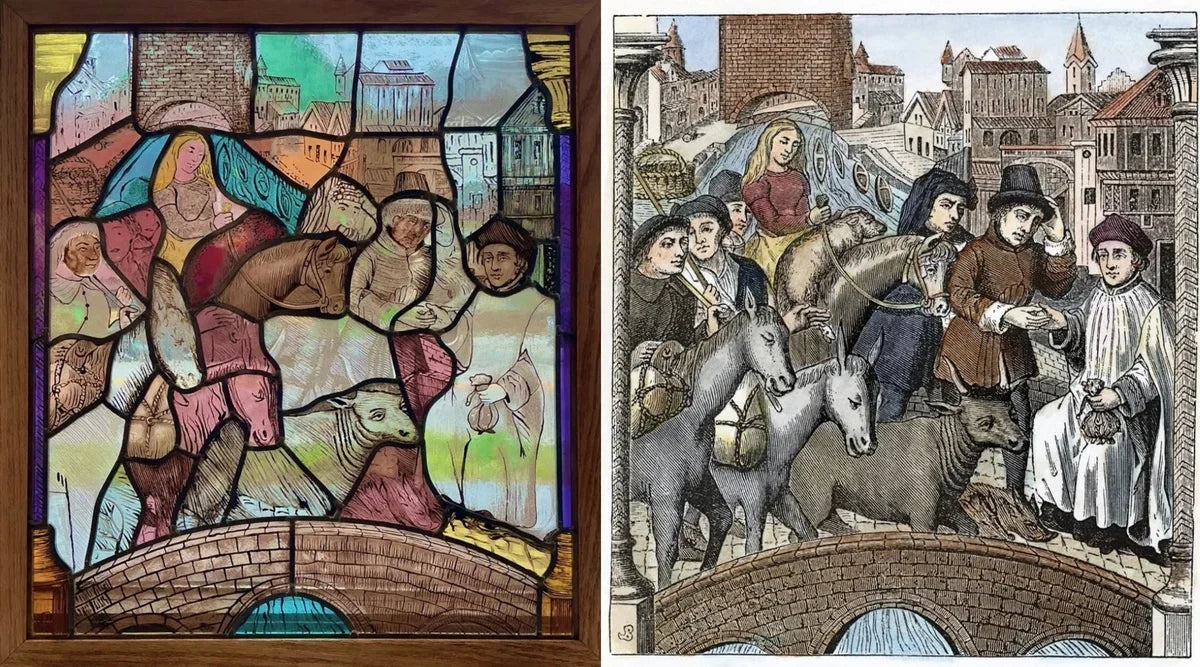
Above: On the left is the final (21" x 23.5" framed) collaborative work completed by the students of the SGAA On The Road painting on glass class. On the right is the reference pattern that the students worked from to produce the collaborative panel.
Earlier this month, Potekglass had the pleasure of hosting glass painter Indre McCraw for Fundamentals of Traditional Glass Painting and Silver Stain, part of the Stained Glass Association of America’s On the Road program. Over three days, students explored the foundations of traditional painted glass, learning how trace lines, shading, and color can transform a sheet of glass into something remarkably dimensional.
As part of the class, students took on a collaborative project: working from an etched reproduction of Paying Toll on Passing a Bridge, from a fifteenth-century painted window in the Cathedral of Tournay. Each student translated portions of the historic linework onto glass, carefully tracing the design and building up color through painting and blending. Those individual pieces were then brought together and leaded into a single completed panel.
The project offered a wonderful way to experience painted glass not just as a solitary practice, but as something that can be built collectively. Students got to put their new skills to work on a shared piece while seeing how their individual contributions fit into a larger composition. The result is both a study of a historic work and a record of the group that came together at Potekglass to learn from it. We think it’s a fitting reminder that one of the great pleasures of learning a craft is getting to make something together.
Below: Students at work on the collaborative piece in the Potekglass studio classroom.

Art in the World
Shane Fero

Above: Shane Fero at work on the torch
Shane Fero discovered flameworking when he was just 15 years old. Growing up, a flameworker lived about half a mile from his home, and it was there that Fero first encountered glass at the torch. By 16, he was already demonstrating the craft himself. More than five decades later, he remains excited by the possibilities of working glass in the flame, a process that has become not simply his technique, but his artistic language.
Fero’s work is perhaps best known for its birds. These colorful, fantastical creatures appear throughout his work, often hovering somewhere between recognizable and symbolic figures. On his website, Fero quotes Carl Jung: “In ancient Egypt the ba, or soul, was thought of as a bird.” The symbolism is fitting for an artist whose interests extend well beyond the traditions of glassmaking. With a background in philosophy and an enduring interest in anthropology, mythology, psychology, and Surrealism, Fero has spent his career asking what flameworking might express beyond the technical possibilities of the medium.
As Fero explained in an interview with Talking Out Your Glass, when he was in his early twenties he began wondering whether flameworking could be used “to express philosophical things, psychological issues," to take the technique in a new direction. That idea has become central to his work. “I’ve never really been influenced by the glass movement per se versus art in general,” he says. “Especially modern art or surrealism. There’s so much potential and so much room for personal expression and that’s what excites me.” Looking at Fero’s work today, it is easy to see that sense of possibility: the torch is more than a tool for shaping glass. It’s a means of giving form to symbols, often through a combination of beauty and humor.
As one of the early artists to push flameworking toward contemporary sculptural expression, Fero has also had a front-row seat to the medium’s remarkable growth. In the interview, he reflects on seeing younger generations of flameworkers take the technique in directions he never imagined when he began: “I just find it fascinating that it could evolve into this. I don’t think I ever imagined it.” There is something fitting in that perspective. After more than 50 years at the torch, Fero’s excitement seems to come not only from what he has discovered himself, but from the possibilities still being opened up by those who come after him.
Below: (1) Goodbeye Summer (n.d.), 21" Height, Flame-worked and blown glass, Corning Museum of Glass collection. (2) Ruby Warbler (n.d.), 5.5" x 6" x 3.5", Flame-worked, blown, and acid-etched glass. Private collection (archived via the artist's studio). (3) Rose-Purple Spring Pot (n.d.), 11.5" x 15" x 8", Flame-worked and blown glass, Private collection (archived via the artist's studio). (4) Cerulean Song (n.d.), 24" Height, Flame-worked and blown glass, Private collection (archived via the artist's studio).


Share:
November 2025 Newsletter